Showing posts with label Log. Show all posts

Thursday, 25 February 2010

Log 1/4.17: shinyshiny!


Yes, it's finished. The first two pages done.
I have a face like bubblegum
badumdumdumbabababadum

Can I maintain?


On a more serious note, I would like to point out that i am not talking to The One here. I don't want any more accusations of being a stalker... that would ruin my plans for the rest of the week.

Now all of that's out of the way, what did I spend today doing, dear log? Well, I worked in the book store - found lots of shiny things there - all morning, came home, meditated for 45 minutes. Forgot about lunch, approached the thing that glares - my script - gingerly, picked it up gently, rewrote the imagery for [some amount of time]. Blew my head off, lay on the floor for [some amount of time]. Meditated for 45 minutes. Wandered around the internet for [some amount of time]. Meditated for 45 minutes. Ate. Threw up on my blog. Meditated. Now I'm writing this. [also wrote random stuff on facebook in between everything else].

Thou Shall Not Throw Up in Public


Stuck my foot in it again.

Monday, 22 February 2010

Log 1/4.14 - Status: C.M.T.O.

Revisioning the script once more, infusing it with newer forms, new turns of phrase and nuance.
This afternoon I shall repair my blog, which finds itself scattered; update the dictionary and the links, mainly.

1. Hours with a thesaurus and internet-dart-board, really milling the words, -- compounding -- them into something beyond mere information - to extract an essence of dream. I ended up with 143 words after weeks of work.
2. I then wrote in the imagery. This was important because the monologue being of dream and detached, I -- my -- authorial voice needed to anchor them in material imagery. This produced 1200 words to back up those initial 143.
3. Mirrors: the monologue is echoed in the scenery, the character echoed in the language. Looking back over the log, particularly to my links, the images are not random. They are projections that become increasingly tuned. I'm milking them for all they've got. Voices are overlaid one atop the other, the narrator switches between masks, though the character is never off the page.

C.M.T.O. - i don't have the first idea of what it means to approach the page lightly. Pretty much any page I write I come to purposefully, and the more of a page it is the better. Letters, emails, notebooks, drafts; to boys, girls, teachers, friends.

16:38 Blog sorted. Words finished. 16 days ahead of schedule. Play time.
16.39 Lots of time for Regardie's body awareness exercise.


Saturday, 20 February 2010

Log 1/4.12 A Mechanics and Geography of Dream.


Space is everywhere.
When I strip away the sentimental value of Earth, of Home, when I lose my perception of Earth as being the centre of existence, then I find myself on a rock in outer space. Outer space is the only space.
Between all matter is emptyness; Space. Quantum theory suggests that on a subatomic level there is no difference between being "here" and being "there". Space is everywhere.
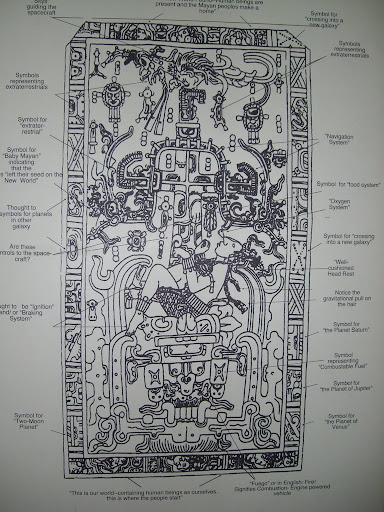
In 2003 I built myself a spaceship similar to the one above. What happened when I used it was this: I spontaneously combusted. Literally. I felt the vibration of each and every atom increase until they spun apart, and I was nothing. Paradoxically, there I was. This experience had absolutely nothing to do with drugs or religion.
I'm not entirely sure that I woke up in the same universe that I left.

I Built This Spaceship in order to investigate a theory that was itself born of a previous vision. That same year I awoke one night in the "lightwater realm", breathing water. The walls of my room glowed orange and yellow and seemed to be made of music. Everything glittered church bells and soft symbols.
I had no fingers. This was a little disturbing, but not as disturbing as the fact that I was shrinking, growing younger and younger until I was a baby and still shrinking. My first reaction was to reach for a cigarette. Bad idea. My tobacco pouch launched itself like a rocket into the air, taking the ceiling with it, and leaving in it's wake a trail of images like an un-spun cinema reel. Immediately after this every object in the room follow suit, until I was surrounded by walls of images and my body had completely disappeared.
The experience didn't stop there. Everyone of those moving images then open up, until I was surrounded by countless eyes. These eyes then shattered like glass.
Beyond those eyes, the world spun beneath me as a complex series of interwoven circles, all spinning around a centre point.
Space is everywhere.
Reality is a dream.
Everything I perceived is composed of those reals spinning so fast that they give the impression of being one thing: the world before me. This world then became a different sort of territory for me - it was inhabited by other beings - dreams - that I do not notice on an ordinary level of awareness. They exist within this thing I call "reality". The dreamtime and the....'wake-time'....are interwoven, and both are simply platforms for the creation of story.
We are playing a game we have forgotten the rules to. My dream-self and my waking-self have become separated not by a difference in space or time, but by a difference in perception.
There are plenty of people out there who will disagree with this, but I am not trying to have "the right way of seeing". I am simply using what I have at my disposal.
I give myself the right to be a "schmuck" and to grow a massive ego when i come close to articulating these visions and manifesting them as story. Nothing is more important than realising these visions, than creating a mechanics and geography of dream, not even being a "rounded human being", or a popular one. Truth is, I put myself on the line for these things. When I get close to them, things like drugs, sex, philosophy, charity and even liberty and equality become trite and pathetic. That's just the way I currently see it, and I see those things in myself as well.
But if people need these things to give their lives meaning, they haven't been where I've been. I try to remain aware of the unfolding story in each person I meet, otherwise I would write the world off and shoot myself.

At this time, three things get my goat. I present them here in order of least important to most important: the first is the drug, dance, rave scene - which I grew out of years ago. My personal opinion is that no one in this scene "has the love", no one knows what "all is one" means, and no one is experiencing anything more than a chemical imbalance. Anything you can do with drugs, you can do without them. No one, in my gross opinion, in this scene has anything like the "secret" they think they do. I know a lot of people who will not like to hear this, but it has nothing to do with them.
The second thing are those specific people who like to take control of other people's minds. The "barging", "raping", "cutting" crew who do stuff like attempt to talk to peoples subconscious minds while they are asleep and shock them with violent images when they least expect it. The "psychonauts" who use what they've learnt to further their own quest for power and influence, and who look at other people's minds like they are property up for grabs simply because the people who own those minds don't have the wherewithal to protect themselves from sociopaths.
The third and most important thing that gets my goat is the any opinion or perception based on the idea "that's the way it is". Nothing needs be said about this. These are notes to prompt myself, and I only need to read the words "that's the way it is" to know how much this jiggles my jangles.
These are the things that push my big red button, that offend me on a core level.

So those are the personal reflections out of the way, my gris to the mill milled.

I spent several hours yesterday working on the same piece as I have been for the last few weeks. It's still evolving, changing, and at times I wonder whether I've written the life out of it.
I've been rewriting it and rewriting it, solely those first 200 words, compacting them and refining them and reordering them because even if the first draft was a "good piece of writing" I'm aiming to make it something more than that. Yes, this is a quest for perfection. I'm not trying to get good marks or get an audience, I'm aiming to relay the vision in accurate terms. Dream is the prime component of my mindscape. These 200 words are the voice of a creature from that realm. They have to be authentic.
It's for this reason that I keep going from my desk to meditation to my desk to meditation, because I need to hold a clear vision of that voice. I'm now spending more time meditating than I am writing as at times it takes 40 minutes of meditation to find a single line or image.
The process of this meditation is as follows:
1. Still the mind. Ease away thoughts of facebook, social interaction, work (the three prime movers of my conscious mind at present).
2. Find the voice.
3. Allow the voice to move and create a mindscape.

I can't ask it to do anything. I have to wait for it to speak on it's own terms.
At the beginning of this course I came to the conclusion that I needed to spend less time theorising and more time taking sketches of people and the world around me. This worked for a time, in that it revealed the things that interest me and gave me practice in wordsmithing.
However, things have changed. The ideas are back, the inspiration is back, and a few weeks ago I made contact with a larger sentience that my simple self - whether this sentience is part of me or not does not matter. What matters is that it lead me from one idea to the next, and made the whole world sing with relevance. It was like being on a path that I couldn't get off - even when I left my room, the songs that I played to myself between sessions followed me. Odd songs that I havn't heard in years in shops and pubs that have a pop-clinetel.
The world seemed to speak to me, and here's the thing that interests me: I've just had the biggest rush of my life and I kept it together. This calls for a fourth "truck point".

I've read only one book on writing this month: Alan Moore's Writing for Comics. Tis a very small book, but it said something I've been wanting to hear for the last four months: Have a very good and established idea of what you're talking about before putting pen to paper. I love that. That's what turns me on, baby. A bloody good idea.
The meditation has been my launch pad - through it I've uncovered the ideas that are most relevant to me. I've gone back through those two formative visions and utilised the symbolism from them, the most important element being WATER. Only THEN did I do any research on the relationship between dream and water, discovering things like the "water gate"/"star gate" mythology in media, in conspiracy theory (I don't believe in conspiracy - for the sake of the work, I believe everyone has forgotten what's going on and who runs what, even those people that run things have no idea who runs things), going back into my classical roots to research things like the river of LETHE, and also have a peak at the Atlantis myth for its WATER symbolism.

The LABYRINTH myth is also a prime component of my dream mechanic and geography; it is a place where dreams are born, and in my mindscape it is also part of the waking-world. People who still value the phrases "it's only imagination" and "it's just a dream" will not get what I'm talking about.
These ideas rushed me like a flood gate had been opened, and I suspect that is exactly what happened. Six months of stripping away layers opened up a wellspring of imagination, and THIS TIME I remained in the drivers seat. This is why I've been so happy.

If drugs, violence and reality get my goat, these dreams are what have my heart, and they are welcome to it. I love them - that kind of love that at times will cause me to shed a tear.

In conclusion, the piece is shrinking. I'm no where near 1500 words, but the words I do have become richer and richer. I'm taking all the time of a poet over each line, and forsaking the accredited expectations of the institute, but I have a dream.....

Wednesday, 17 February 2010

LOG 4.11 The Juice is Not the Muse

Having spent almost three weeks working on the monologue and dialogue, I emailed said monologue to an old friend of mine for feedback, which he gave and which was very useful. As a result, i realised that the Parallels Sequence, while interesting, may not be necessary - perhaps best to follow through with the protagonist. And so it goes that several days of work go back in the draw, to ferment for a later date. And by days I mean long days and sleepless nights, sweat, blood, perhaps the occasional psychic tear. By days I mean, like, 30-40 hours of work.

200 satisfactory words of monologue, 11 pages of Action - cause and consequence - later, i picked up the strongest part of the work and began this morning to write the FRAMES in proper. I did this from notes that I made over the last two days. This note-taking bears explanation; I have been using a new technique.

1. Dissecting the monologue: The language used is that of a hunter, but what is the world of the hunter made of? What are the words made of? I went through all the key words with a thesaurus and made lists and correspondences, with the development of a Military terminology and a Culinary imagery, with implications that the character is "rough-cut", "keeping on foot", related to "sappers and miners", that he is a stepping stone and a ripening scaffold. Equipt and Forecast also made it into the equation.

Headline: Military Culinary Miners Ripen Scaffold. [sic] (this has nothing to do with anything).

2. Making Images from Words:

This phrase:

Attuned to rhythms run
Through splintered rumours,
Footsteps echo
In idle gesture and disembodied words.

...does not in itself conjure an image, at least not to my mind. It describes a process, but gives no visuals. Thus, I have to come up with an image that would echo these words, giving them a sensory anchor (using five of the senses) lest they become jibberjabber signifying nothing.

Rhythms = Car lights as if in fast forward, a blurred image of a crowd moving towards an underground station
Run = a running man highlighted in contrast to the blurred crowd
Splintered Rumors = TV screens instead of shop windows, littered with slogans
Idle Gesture = Crowd reactions to the running man
Disembodied Words = Perhaps a repetition of "splintered rumours"

3. Making Images from Vision:

This is where the "meat" came from. Rather than follow the words on the page, letting them paint a picture, i used my head, my inner vision. I wanted a clear picture of this place inside me where the action is taking place, and so I used meditation again. I didn't rush it - it took me over half an hour just to get the first frame of 5, which has only the caption "I know no peace". Why did it take so long?

Because I'm building a city, a whole city, a whole world. It's not just "one frame" or "one line" it's LIFE. Life has detail.

I have been called imaginative, astute, observant, creative, artistic, with an eye for detail and a flair for nuance. This is - with no disrespect to either myself or those who have provided me with these perceptions - rubbish.

My imagination is a spasm, a knee jerk, a premature ejaculation. It needs training, and not just on an academic, technical level, not just on a level where a skill with words builds up - i need a skill with vision. With seeing. And I don't just mean observing the details around me, I mean observing the details within me. My inner landscapes. I need my ideas to be more than a phantom that haunts me, taunts me and propels me upon the page - I need to hold the vision, to hold the image.

If anyone was to ask me now what the difference between having a skill with words and having a skill with vision is I wouldn't be able to tell them, but I do in truth suspect my vision to be independent from words. A precursor to words. Maybe it's not enough to let the words flow and build an image - vision is primary. Vision came first, and I am letting the vision find the words.

This brings me on to the current creative paradigm that appears to be dominant in academic teaching - that there is a formula to everything, that writing is a craft and that the "muse" is a "myth designed to mystify art". Jeez, I don't know where to start with this one. My suspicion is that people with this view have fallen out with their muses, and that this opinion is tantamount to "ya know, I never really loved her, I just thought I did".

I beg to differ!


Sunday, 14 February 2010

Log 4.9 A Complex Dream, A Simple Character. Fuse.

Three things of interest have happened today. The first is that I've been distracted - it's been a while since I was distracted by anything. I've had quite a run - a good month of solid focus.

The second was using the exercise of speaking my writing, giving voice to my characters. I did this with the superhero's monologue which opens the story, trying to get a feel for whether it was natural. Quickly I established what belonged to the character and what belonged to me-as-author. Some of what I'd written was information rather than expression of a character, and I cut it out with some success.

While contemplating doing this exercise I realised that I was too distracted to focus on it wholeheartedly. I was also afraid of speaking the character because I felt that it would just sound trite, so I tried to get into character first. Before being able to get into my character I realised I had to get out of myself. This was a significant learning, and it is the reason that meditation is becoming a part of my writing practice more than it is a part of my health of wellbeing practice (which, truth be told, I don't really have).

This bought about the third interesting part of today. I realised I need to organise my space better. I have been writing, reading, reflecting, meditating, researching, plotting, mapping, planning, breathing, eating, sleeping, and getting into character all in one space - a space that takes up about a third of my room. I need to set aside different spaces for different parts of the work, and also make sure that I can keep life and work separate. I decided upon an experiment to this end - blacking out a portion of my room using fabric, black so that there are no associations, no imagery, no colours, in order to both meditate and explore characters, scenes, phrases. The difficulty is that I don't have the space to have an area for "IN" and an area for "OUT" so I will have to devise some sort of boundary marking techniques. It has reminded me that I should definitely get around to building that spaceship.

What I've realised is that if I don't embody the character and really get to know it on a personal level, it remains trite, just words and thoughts.

I'm also having difficulty with my five other characters. I managed to run the script parallel which is interesting as a dream sequence, but the story is weak. As an example, the Scientist is being interviewed by a television company and speaking about the N.U.I., thus delivering strictly factual information. There is no nuance of character, and she is nothing more than a plot device.

Perhaps I should start in medias res, and then have her converse with another character but in the same manner that she talks to the interviewers, as if her being in the world is defined by delivering factual information. Better yet, forget the interview altogether, and have two characters discussing the machine who have an different agenda from the protagonist/supe - media moguls, for example, who see the potential of using the machine as an entertainment device.

In conclusion; the superhero is going well, not yet fully formed but going in a good direction. After writing this I will return to paper and pen and dissect his monologue, paying attention to his language.

There are two important defining elements to his character: a) that he is of dream, and b) that he is primal. Thus there is a need to create very, very simple and emotive language. The use of the word "riddle" and the word "labyrinth" concern me a little. They are dream words, true, but they are not simple. Here is the conundrum: creating a character "of dream", which is complex, who is simple - single minded, primal. That is something I will enjoy, I think.

For now, with regard to the course itself, it is enough to focus on this character with this approach. If i can fit in just one or two other characters but the end of the month, that will be even better, but not if it is at the expense of the superhero whose form is rich and becoming richer.

Saturday, 13 February 2010

Log 4.8 So far, so far

I've done what I set out to do at the beginning of the month. I've turned an idea into a script - i havn't yet written out the whole thing as a script, but I have the dialogue, the scenes, the story. Were I to write it out as the script I will submit, only about a quarter of what I've written would fit the word count, and I've only written half the "issue".

It begins with a superhero, who is the dream self divorced from the protagonist, a primal force whose only motivation is 'The Hunt', the thing that joins the dots and chases, hunts ---

The waking self.

While I'm still only just dipping my toes into the writing game with any sense of integrity and purpose, I am still trying to avoid cliche. I do not wish to construct a post-modern superhero in the Alan Moore sense, one who is motivated by personal agenda's and various neuroses. What motivates [The Shadow] is the hunt. I have this idea that characters like Batman are who they are because they are in touch with their animal selves - obvious when I think about it. [The Shadow] is what he is because he's in touch with Dream itself - and in this work dreams are not fluffly wuffy safe places to be. They have big teeth.

The story is essentially about uniting the dreamer with the dream, via an explosion of spurious ideas that turn the world upside down and inside out. It's in no way as simple as 'you have this world over here, and it's real. You have that world over there and it's everything else'. The dream self is as real as the waking self, and this is about what is created when the two are united, fusing those two worlds to create something new.

In it there is a sort of conspiracy by the media to own dreams, to seperate them from the audience so that the audience becomes dependent upon the media to feel alive, whole and like they have an imagination. It begins with a revision of previous methods in the light of the death of what is known as "The American Dream". This death is the reason for Open Auditions and Reality TV; the public are becoming rowdier the more they see that celebrity, fame and wealth are unattainable for the majority. This group of conspirators has the responsibility for maintaing a unified global paradigm, and is now considering providing not only entertainment, but an experience.

They are not the "bad guys", because if they were things would be as they seem, and I'm aiming to move beyond things being what they seem in the story. They are providing a service, in a way, although 'The Old Order' has become decayed as it's members succumb to the pleasures of their own successes.

There is a new technology, which I have fiendishly called The Natural User Interface, which has been designed to hunt down terrorists. They whole thing is set against the back drop of the war on terror, with the two main elements of this war being
a) The enemy is no longer defined by uniform or territory
b) The soldiers/heroes don't know who their superiors are.

Thus the scene is rife for paranoia, the waking selfs cousin to dream, the consequence of two much stimulation, too much information, not enough trust and a dawning realisation by the characters that truth and belief are fictions.

Effectively the machine synchronises the Soldier/Superhero/Hunter character with the Enemy/Villain/Hunted character. The obvious consequence of this would be that one would not know who is good and who is bad, the Superhero would take on villainous characteristics, the Villain would take on heroic characteristics. No! This will not happen, because the machine is not in touch with the Enemy in any way. The Enemy is a construct created by the programming in the machine, L.I.S.T. (living information systems technology) and thus is also a fiction. The justification for this by the "Gov" and the Inventors is that while the programming creates a construct, the Soldiers do actually find enemies.

The protagonist I have yet to work on. Given the genre, and the readership and my own inclinations, it seems obvious that the protagonist will be a 20-30 something "ordinary guy". The S/S/H, Scientist, Media contingent are much more developed than the protagonist, since he only comes into this "issue" half way through and I havn't had a chance at all to work on him yet. So far he has had an experience of his partner becoming divine during sex, which then initiates a psychic breakdown that ties in with the S/S/H synchronistic hunt in a round about way - both events are essentially the same thing in different worlds.

All of this is why I have given the piece the working title of "PSYCHONAUT".

I hope that having these different characters will mean that I have sharpened up my voice and POV skills, and have given myself the challenge of having my characters echo each other through different paradigms.

Writing all this it's clear to see who and what my influences have been. I don't, however, feel like I am copying anyone or rehashing old ideas since the "issue" is largely based on my own experience. Primarily, even. There are themes here that have been in my heart and in my head for pretty much decades. Dream is the most obvious one.

Man, if anyone has sat through a class room of people telling you "You have no idea of the real world" while they spout tired and trite but acceptable cliche's and moralisms, you'll know what I mean.

Personal Reflection: Wow. How alone am I. All dressed up with nowhere to go.

Wednesday, 10 February 2010

Log 4.7 Score.

Pages 1 and 2 of the PARALLELS sequence done. A first draft has emerged, with this unplanned consequence:

Holy christ on a bike, I can't even explain the consequence. It's non-linear, that's all. No intellectual masturbation involved - the three columns stand alone, run side by side, can be read backwards, up and down, left to right, and it still tells the same story.

Lalalalalalaaa........

:-)

Tuesday, 9 February 2010

Log 4.6 New Forms

N: Bwwwaarrrggghhhh, behold my thousand horrendous forms and me mates thousand eyes, blllarrrrhhhgggg
S: Dude. Please. I'm blind.

Yes! I'm getting into the swing of this. Form and Content - I love unify these, harmonising them. It's what I've always loved best, and the FORM of comics has really got my juices flowing.

I've turned the Soldier character into a superhero. I'm getting this........finding my own way with my imagination. All those things I used to be afraid of approaching are coming to life.

Ah well, I guess that's all I've got to say.

Monday, 8 February 2010

Log 4.5 Spazzing Ooot

"I needed a reason".

The introduction I'm not sure of. Thinking of cutting it out and moving straight into the parallel stories for now.

THE PARALLELS: PAGE 1: Addenda.
1. The three stories are to run vertically.
2. The three stories are to be read horizontally and vertically.
Thus, They should all be the same narrative; the MONOLOGUE of the protagonist through different lenses, with the conclusion occuring outside of these parallels. The POINT: To show that the man has been splintered. Breakdown in central organising fantasy. PTSD.
2.2. The narrative is NOT the same thought from different perspectives, it is a continuous, linear narrative that runs through the three stories.
3. Once this has been achieved, the stories are to be coherent when read clockwise and counterclockwise, illuminating different themes in doing so. The POINT: Perception as self-fulfilling prophecy.
3.33 It shouldn't matter whether the reader actually does read the thing from all these different angles. Each story will make sense it itself.
4. The narrative here is based upon the protagonist experiencing different parts of himself as divided.
5. The narrative will evolve into a synthesis of those divided selves.
6. Once these characters have been synthesised, they will be revealed as 5 individuals regardless, as one soul in five bodies.

Friday, 5 February 2010

LOG 4.3 Montage- FORM and CONTENT

Coming along, coming along.

It is an episode that sets the scene of the novel, giving back ground information, describing a few of the devices, flashes of back story, and a pivotal consequence of using the N.U.I./L.I.S.T.

Thus, it is plot-heavy. Page three introduces three characters: TRENCH, MOYON, PHILLIPE, page 4 introduces another character: AIMEE, page 5 introduces another character BRAZIL. The effect is to give a world view, to introduce all the characters immediately, to show their differences immediately, with emphasis on the difference in LANGUAGE AND STYLE. It will appear as a sort of MONTAGE.

I have most of the LAYOUT done, having scripted the NARRATIVE STRUCTURE, wherein the shape of the frames is as much a part of the story as the dialogue. FORM and CONTENT.

This done, it is time to bash out the dialogue and then refine it, finding nuance.

Thursday, 4 February 2010

LOG 4.3 Concepts

1. I'm writing a script for an episode of a graphic novel.

2. It is difficult because I am in a sense forsaking my turns of phrase and poetry in favour of a narrative structure.

3. My intent is this: to write a story from beginning to end, and not break my back over it's beauty.

4. To have a complete narrative form, the bare bones - a to b to c.

5. When this is accomplished, I will pay more attention to the characters, adding nuance and human elements onto the skeleton.

5.2 This may change the structure. So may it be.

Amen.

Saturday, 30 January 2010

Memorable characters have something in common:

A juxtaposition evolving into a sublimation thus creating nuance.

Examples:

1. Ordinary Joe becomes super-spy (The Filth)
2. Preacher becomes gunslinger possessed (Preacher)
3. Soldier becomes holy man (The Sadhu).

So far I have this: detective goes on the run. The hunger becomes the hunted, probably the oldest juxataposition in the book.

So - strictly rational detective goes a) on the run, b) in search of god, c) by becoming a renegade sufi clown conjuror. Ah, fuck it, I'm going to bed.

Log 4.2. Stuff

I'm torn. I've got a good intro to part two of what is now the graphic novel which is now titled PSYCHONAUT which is now becoming this months obsession which is now leading to burn out and has thrown me back onto the meditation cushion after a 6 month break from practice.

Why the graphic novel format? It simplifies my writing, and makes dialogue richer. And oddly i like the format - the script. I didn't expect that. The thing with graphic novels is you have to know WHAT is going to happen next. Ya cannae jist blether fer fourteen pagees.

Language and style is this months project, so initially I've created a character who uses a technology that he doesn't understand. He's an ex-soldier and truth be told I don't know why he's doing the job he's doing this has to be worked out. Anyway, he's now a detective, using this technology to find suspects, to increase the "psychic" resonance between them. Bottom line is he doesn't have to understand the technology, any more than I have to know algorithms to use the internet.

But here I'm torn because part of me feels like this isn't a "real" story. That I should be writing about a bunch of young people in a squat fucking with demons as a twist on the superhero story. Finding themselves in alternate realities and that. But I guess I'm stuck with my soldier motif for reasons I don't quite understand.

Ah, bollocks to it. All I have to do is firm up the protagonists backstory, which I'm working on as a flashback, and his motivations for what he does.

How did he end up out of the army and in a detectives job?
What does he want from the job?
Too tired for this....

Wednesday, 27 January 2010

Log 4.1 Reflections

I got my last piece done despite being dogged by illness. A month of hard graft transformed itself into 4 days of bliss as I became inspired by what I was writing.

I've heard talk that the idea of artists being "magically" inspired, of being swept off ones feet by an idea, is a myth to make ones work seem more mysterious. That artists are in fact crafts people and spend long hours learning a skill. A rather cynical academic approach, in my eyes. Why would anyone sit and stare at a blank page and then string words together in the nowhere of their offices if not for love? Money? Do me a favour. Writing ain't worth money. It's too painful.

Anyway.

I felt like I'd finally found a way to clearly express all those idea's I've had building up over the years, without degrading or relegating any of them. That was quite something.

So it's turned a new sorta leaf for me, in that I'm now looking into graphic novels as a medium for the next month. The novels will take a back seat as I immerse myself in the unsung complexities of comic books: the terminology, the style, the collaborative elements. Writing scripts rather than prose, I guess. Not that I'd be able to avoid writing prose.

There's something about their "punchy"ness that I enjoy. No beating around the bush, no drawn out reflections on root vegetables. Just POW. Pow.

So I read a couple of the last couple of days, PREACHER and CONSTANTINE (odd how my last post actually reflects the use of CAPITALS in scripts, as if I was trying to say something to myself, or maybe I'm doing that now and there's nothing odd about it at all and it's just a coincidence).

With the course I've managed to work on my dialogue and narrative so that "stuff happens" and I don't just think and reflect at length on the nature of root vegetables (a habit I was getting into on my own). To begin with my greatest struggle was not stringing words together to create pictures or emotions, that I had at least a rudimentary grasp of, but creating a...dialogue?...a beginning, a middle and an end. Creating obstacles and resolutions. Now I'm getting that down clearer and clearer, and I've just finished penning a first draft of a chapter/episode/issue. Complete. Beginning, middle, end. Short, simple.

"Short, sweet prose" Alan said, "don't try to astound". Graphic novels are good for that, writing them is good for that, since I'm just trying to get to the point. None of the emotional impact is lost, it seems to me, the way I feared it would be if I didn't draw everything out and use big words or essay-ist explanations.

Just POW. Like a breaking wave.

After the last month my dialogue is good enough for me to compose a sequence and not feel like it's just myself talking to myself. If the parts of the course devoted to scene and characterisation taught me that my language creates a bigger picture, that it should resonate within itself and amplify itself through its continuity within the piece, then dialogue has shown me that the story is a DIALOGUE. It was the essential missing ingredient from my understanding of art (thanks Jo), or my most unrealised ingredient. I feel like I can make stories happen now.

So i wrote this narrative, an introduction in first person, a meeting with an old friend, a flashback. I penned in a few brief notes on movement and posture as I went through, and visualised the scene.

Came to 1200 words.

And I have no descriptions of the frames.

The frames, man, the frames! It's a whole other world. Perhaps because graphic novels are broken down in scripts into chunks - dialogue, scene, caption - the nature of prose is easier to grasp. And fuckin hell its fun to work on a comic. It's fun! I'm enjoying myself. Why does this feel like a bad thing?

Anyway.

I realised that I have no idea what the frames look like, how they run in sequence. I have a basic idea of a man walking through a city and ending up at a church during the first page, so there's this basic idea next to a developed dialogue and it's hard to piece them into a NARRATIVE, to unite them.

That'll be the next challenge, and its a challenge that wouldn't have even presented itself where I to stick to prose. Probably because I'm a bad prose writer, but ya know...that's by the by. Something about having to synch everything in a graphic novel feels more complicated than synching it in prose - perhaps because the dialogue and the scene are, in the case of a graphic novel, different mediums.


Monday, 18 January 2010

workworkwork

I've been working on something for a couple of weeks, something that could be described as a noir, science fiction mystery thriller WITH DIALOGUE. Ideas are coming together and my writing is improving, so that I feel like I am working on something specific, a brainchild, that THING thats been LIVING in my HEAD since i fell out of time and into the collective imagination. And I could go on about how I'm using everything I've learnt up to this POINT, and that this course is the best THING i've done in a long time, possibly my whole life, because it is drawing together my ideas and not impoverishing any of them the way SCHOOL did, or university did, but encouraging them, growing them.

The story is about self and other and place inbetween, about the FICTIONS we are the FICTIONS we LIVE by, about a simulacrum called STANTON which is where all the unsolvable and incongruous elements of B.T.'s existence find a space to dwell unincumbered by the DIVISION from earth that we call HISTORY. Where London is a fiction, and the only real thing is a biocomputer that calculates statistics and is ultimately meaningless.

It is about the COLLECTIVE CONSCIOUS being divorced from the individual and becoming almost autonomous, about its collusion with TECHNOLOGY to create an independent body that will be listened to, but which is some how monsterous because it has been divorced from humanity.

It is about not ONE world but MANY, layered and overlapping, with different times cohabiting and while our world is defined only by selective attention.

It is about all of philosophy being about creating a link to the collective lest the collective become so divorced. It is about the telling of an awakening that will occur with or without humanity. The Goetia is in there, as both a collection of humans, a prebiotic sentience and as an autonomous technology. It is essentially about projection, about creating angels and demons external from the self, and it is about the internet.

That, today, is what its about.

Now, how do I make it different from what's been done before?

Sunday, 10 January 2010

Reflections

I'm very close to finishing reading a novel, in bed with lemsip and cigarettes and trying not to get ill again. It's taken a long time (a month) to read this novel, and I've enjoyed it. Thus, I want to finish it. But I can't! I'm thinking about writing.

I'm half way through the course now and I didn't even notice it. A 12 month course and I'm half way through in 2 months. Thats the way, uhuh uhuh, i like it, uhuh uhuh...do do dooo do do dooo do do -- DO --

A review, post haste:
Part 1: spent the whole time rewriting exercise 1 of about 10, possibly 15, forgetting that the rest existed. Ultimately, my assessments were made up on the spot. 2 poems and 2 pieces of prose born of pure necessity.
I learnt: to use all five senses when creating a scene, to free write and then highlight what I wanted to keep, underline what needed to be improved, and isolate those nuggets to be reworked, i.e. metaphors to be made more lyrical, more poetic.

Part 2: I did all the exercises and had about a week to do the assessment, which was jolly good n' whatnot.
I learnt: to use a thesaurus - to expand upon my lyricism with selective words, to get to know my language and to get an understanding of why i've used that language, of the bigger picture involved. I learnt how to echo character in place and place in character - vital.

Part 3: I'm half way through. Its dialogue, so completely new to me. I'm learning to expand what I've learnt previously, to build on it - to tell the story through different characters points of view, still using scene to inform the reader of whats going on. I know need to learn to mirror character in place in dialogue and dialogue in character in place etc, to turn all these elements into plot.

I've been laid low since my last assessment with weeks of illness, and my prolificity has been mediated by it. I need to work through these exercises so i can spend time on the assessment at the end, like I did last time.

Now, I aint a bad student when it comes down to it, but it isn't in my background or experience to organise myself as effectively as some other manage to organise themselves. I had to learn from each of these previous parts of the course, to develop my habits through them. The first thing I learnt was to do all the exercises and give myself time to do the assessment at the end. I still do most of the exercises at least twice, and take at least twice as long as is suggested to do them.

Now I am learning something important: I need to keep track of what I've done. This blogger -- is shit. Its a bad lay out, doesn't print well, I can't see my entries back to back, nor flick through them. I need a hard copy. i am now thinking I should revert to a paper journal for these entries, since the media - which would more be more appropriate for a common place book - has dried up. When it comes to it, I can "paste" (using PritStick) anything i print into the book.

Further, my folder of drafts is my saving grace. It has kept everything together.

My common place book is the weakest part of my skillset, since it is abyssmally scattered between here, a file, a book, face, my draws, my walls and my floor.

The most important points in all of this are thus:
1. Keep things together, and make a hard-copy learning log. I need to be able to see my work-over-time laid out clearly.
2. Sort out my common place book. Do more research on the people and places I'm writing about.
3. In each part of the course, use EVERYTHING i learnt in the previous parts.
4. Keep taking at least twice as long to do everything, and doing it at least twice (although I've done the last exercise 5 times now, which is becoming a common occurrance).


Dialogue

AM:
I began to read a book about espionage and Charlemange. I picked it up for the labyrinth motif, and the mystery of what happened to the protagonists father. I was very disappointed in it. The writing was terrible. It was like reading a colour-by-numbers detective story, or like a transcript of a TV show. The characters were one dimensional stereotypes, although all the ingredients of "good writing" were there: scenes were set well, information was given, all five senses were used, but it had no depth.

I have been conflicted recently, wanting to write something that touches on what it is to be human, an existentialist drama, and at the same time wanting to use a mystery genre and some novelty ideas. The idea of writing a detective story seemed to jar with writing a piece of literature. I wanted my character to be an ordinary person that stumbles across a mystery. Then I realised, a detective is an ordinary person, and that was what the Charlemange book was missing. Everyone was a stereotype. People pull out guns for no reason, except "that's what happens in espionage stories".

So I've let Ben Trovato, my existential occult detective, infiltrate my story about Fat. Fat is now Ben Trovato. I've moved on from Fat coming home with his fathers diary, and introduced Suzanna, who I took for the student handbook, where she is defined as having "no job, no funds, no hope". I made these characteristics a spiritual practice and began a dialogue between them that explores their individual philosophies and why it is they do what they do. I havn't paid much attention to the student handbook otherwise, except for this morning when I read the dialogue guidelines:

"Dialogue must never be written for its own sake and should always have at least one of the following functions:
1. impart information (8/10)
2. enrich the characteristation (8/10)
3. move the plot along (6/10)
4. develop the characters within the story (8/10)
5. further the complexities of the plot (3/10)
6. crank up the pace (3/10)
7. enhance the theme or core truth (8/10)
8. reflect relationship changes and emotions (6/10)"

Beside these functions I have given them a mark out of ten for how well these functions are served in my dialogue. None of them is missed out. Again, it seems only natural to me that these functions are what a dialogue should be about. In the Charlemange book, only one or two of these functions is served at a time, which gives it the paint-by-numbers feel.

The characterisation is enriched because both characters are talking about backstories, their own, and comparing philosophies at the end of a week. The complexities of the plot are thickened, in that we learn of Trovato's motivations and personal ontology. We also learn of Suzanna's. Their relationship is illustrated, and the core truths are begun in their philosophies.

It's little more than a first draft at the moment, but I'm happy with the information that has been developed, and with the themes revealed.

The guidelines also state that dialogue should be kept short, which I didn't do for Susanna because she's telling an emotionally charged story. They are swapping stories, which means that their speech will be longer than usual.

One of the things I've noted is that for every guideline proposed by this book, there is a novel I'm reading that utterly disregards it. This is what makes me think that writing "is" art. Even the guidelines are arbitrary, and I can't help but feel sorry for the people who read this stuff and stick to it, probably writing more than they read and never realising that the guidelines are just a prompt.

PM:

Wrote more dialogue, once between Suzanna and Ben, and twice between Ben and "Loisha" (actually two very different characters). Dialogue improved each time, although I was least pleased with the second attempt.

I also read the course text book for once. It says that you need to have a very good idea of character in order to generate dialogue, of their conflicts, desires, histories. I had to flesh out Ben/Fat considerably in order to do this, which I did by freewriting and creating a family tree. Suzanna and Loisha are essentially the same character, with modifications here and there. There's a relationship developing.

I merged project 3's exercise 3 with project 4's first exercise using an african-scottish dialect, which provided some good ideas and a good sense of character. However, I'm stuck with my detective. He's yet to have a case to solve. I think the best way to find one is through having him converse with lots of different characters, at this stage.

Saturday, 19 December 2009

Log:2.5-4.2

One more exercise to go, and a week before the deadline. This should give me enough time to polish and prune the piece i knew I'd submit when I wrote it - the Dunn St. bit. Still ill, have resorted to reading fiction in bed.

Reading 'The Vanishing'. What stood out was that a great deal of information was given in the very first paragraph - introduction to the scene (first of several references to space and space-travel), to the two characters, to their psychology, how this trip they were on was different from others, the time of day, the time of year, their destination etc etc, all in about 50 words. It felt like you knew the characters immediately.

I turned this lens onto my piece about Dunn St. and it appears that what I've written could be more about the street than the first person I meet in it.

What I have to work on now is sharpening up the mystery of the diary - which I've decided fits in well, and am also planning on making Justin dyslexic - and adding another 100 words with portents of the future; where he's going and why. Its a 'mundane' passage, in that nothing blows up and no one dies, but its got some good tension, especially in the "imbroglio" of the street and the "pastiche" of the buildings. My concern is that I've over described things.


Friday, 18 December 2009

LOG:2.5-4

Yeah, so, 95 pages in the last three weeks, not including anything in my notebook, and every single page I've poured over for hours with red pen, highlighter, black pen, thesaurus. Its been exhausting really, and I still feel like I'm fumbling around in the dark, unsure of things like a common place book and this learning log itself, confused by reflective commentary and all those things that support my writing.

Only two exercises left, so I think, considering I have flu and am barely out of bed, I would do well to study rather than write for the next week. Read through the course book, looking for things about common-place books and commentaries, perhaps finish Kings "on writing", peruse "elements of style", do some research.

I would be happy to submit my second to most recent piece entitled "Negredo", and imbroglio about the fictitious Dunn Street - really, I don't know where the imagery for that street came from, certainly nothing I've written recently, but it reflects the character and vice versa - except that there are a few unharmonious elements.

The most notable of these is the protagonists fathers notebook, which gets dislodged from a shelf in paragraph 6. Nothing wrong with it in theory, but its a clumsy addition, remniscent of my attempts to write to much, sticking cats and burials and office jobs into a simple ghost story about a grave yard, a la project 1. I guess its sort of a stand alone element, too removed from the rest of the piece.

Actually, the idea of a diary fits well with the grafitti on the street and the bag lady picking up old newspapers, and perhaps I shouldn't lose it. Maybe its just that paragraph that needs tightening up - i've noticed something of a trend, whereby the first two paragraphs are strong, and then the rest get progressively weaker. Rewriting it I might make the third paragraph as a strong, then the fourth with the second rewrite, then the fifth with the third. I don't seem to make much of a mark on the thing as a whole, but seem to work progressivly through the paragraphs - the character leads me through a story, clearly at first, and then I become tired as I go along and the piece loses its clarity.

Time for draft 5?

Redrafting is the most valuable thing I've learnt so far. Before I learnt how to use a highlighter and red pen in this context, together with a thesaurus and my notes, I never would have known where to begin with a redraft. Now I eat them up and churn them out, draft after draft. It's a skill not to lose the original 'zen' of the piece, which is always perfect to begin with, and only alter the form.

I managed to get out and do some sketching this afternoon, which was good. Nice and simple, no pressure to create a story, just trying to capture a moment instead, to improve my writing rather than my ideas. This sketching still needs to become more of a habit, though.

Tuesday, 15 December 2009

Log 2, 5, X: Riding the Wave

The new draft, which I've called "Dunn St"...well, it fucking rocks. Its a little piece of bile fermenting in a heat wave, a blast of hot air, a tasty synthesis of character, scene, history, motivation, psychology and any other ingredient that might be important but that I havn't noticed because I've been writing it in a trance and havn't stood back far enough to see it all.

I've written 350 words of a second draft tonight, after going through the first with a red pen (what was that about?) a highlighter (thats what I'm talking about!) and a black pen (add this). I then took out some key words and devoured a thesaurus, taking a page of notes on the first paragraph. I could spent hours going through a paragraph at a time, and am honing this skill. In the end I wrote, four paragraphs, extrapolated from the mood of the first and incorporating the information of the first drafts first three paragraphs. Same amount of words, tons more POW.

There's a lot in it - no filler. Everything fits snuggly; its claustrophobic and breathless, full of commas with a dearth of full stops. An imbroglio, everything a symbol of everything else.

What have I learnt? I should learn from previous drafts, and write something new. Yeah, redrafting is a good practice, and I couldn't avoid it if I tried, but when it comes to the next exercise i should abandon what I've written, taking the themes and the moods and the style if useful, but not the words.

NOT THE WORDS!

Not the words. The themes, the mood, the style, maybe even the action, but not the words.

I can't really explain why, except that the words become deader and deader. They need to sit and germinate for a while, a couple of weeks perhaps, before I approach them again in order to write a new piece and not just a new draft.

Anyway, I'm happy again. I feel I got to my essence with this one.